Talk your architecture into existence.
A voice-controlled architecture canvas. Describe a system out loud; it draws, validates, and stress-tests itself in place.
AssemblyAI Voice Agent Hackathon, 2026
Talk your architecture into existence.
A voice-controlled architecture canvas. Describe a system out loud; it draws, validates, and stress-tests itself in place.
AssemblyAI Voice Agent Hackathon, 2026
Systems are designed in conversation. Diagrams are drawn afterwards, by hand, and nobody checks them.
The whiteboard photo
Design reviews end with a blurry photo and a promise to “clean it up later”. The decision record never gets written.
Diagram tools are slower than talking
Dragging boxes breaks the flow of a design discussion, so the diagram lags the conversation or gets skipped.
Text-to-diagram draws anything
One-shot generators happily connect a browser to a database. They don't know the rules, so they don't push back.
Failure modes surface in production
Single points of failure and synchronous chains are obvious in hindsight, and invisible on a static diagram.
Say it. Watch it build, break, and heal.
Live, running the real engine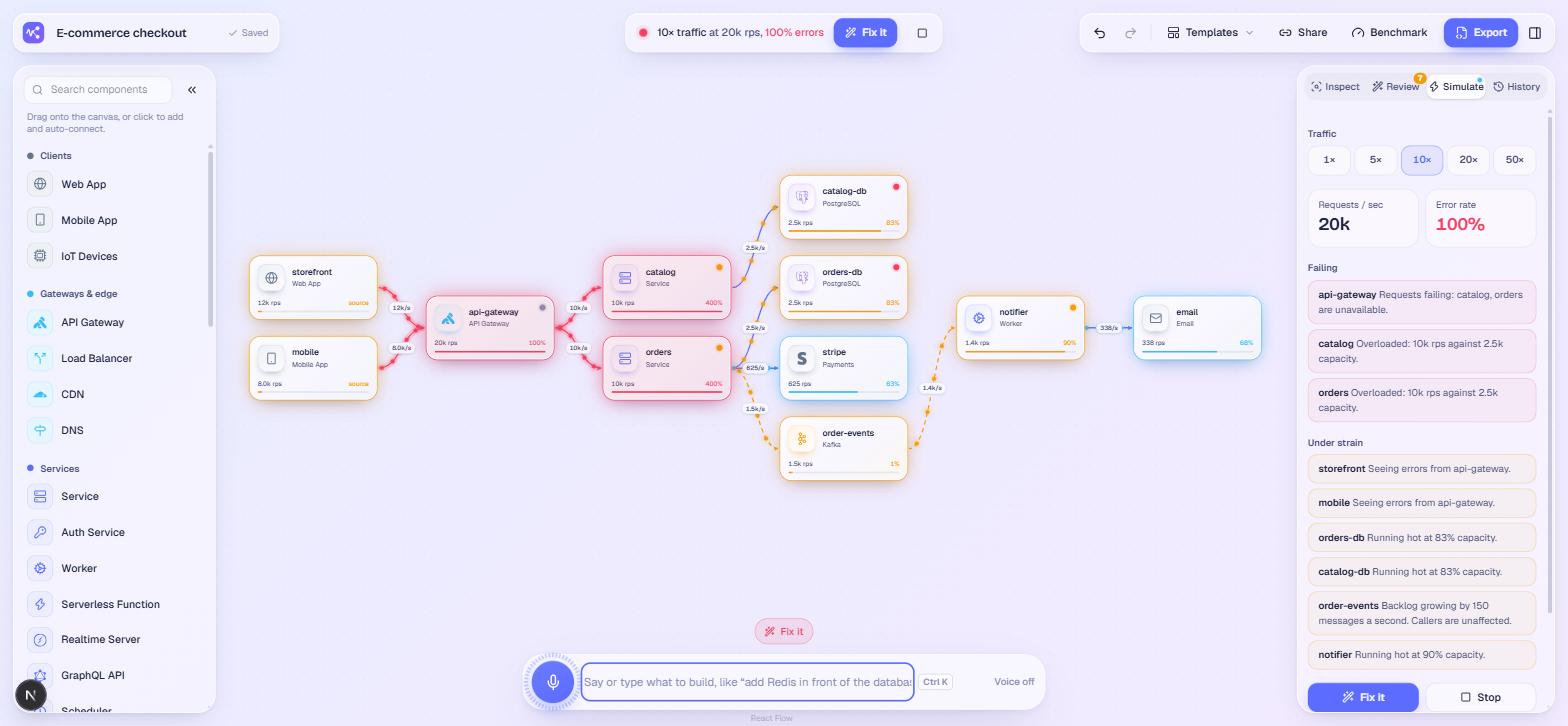
How it uses the AssemblyAI Voice Agent API
One socket, no exposed keys
The server mints a single-use token; the browser opens one WebSocket, streams 24 kHz PCM, and ends every session with session.end.
9 general tools, strict schemas
Add, connect, insert, update, remove, simulate, review, canvas. Enums come from the catalog, and every call is validated locally before it touches the graph.
Edits land instantly, results wait their turn
Each tool.call applies immediately; tool.result is held until reply.done is the latest event, so turn-taking never breaks.
The agent always sees the canvas
After every edit, session.update pushes the live graph into system_prompt and refreshes keyterms with your own component names.
Barge-in and voice undo
Speech flushes playback mid-word. “Undo that” and “redo” are just tools.
Measured, not vibes
The same scenarios run offline in CI and live against the agent via conversation.message: 24/24 pass offline.
What makes it different
Edits in place, not regenerate
Every utterance is a small, typed, undoable edit to the existing diagram, with animation that shows exactly what changed.
A rules engine with a voice
Illegal connections are rejected and explained out loud with a fix. Inferred choices are badged, explained, and one tap to undo.
Architecture you can crash
Traffic simulation and chaos mode turn a static picture into a model: overloads, cascading failure, failover, and remedies.
Artifacts from the typed graph
Terraform, Mermaid, and ADR exports are generated from the same model, so they can't drift from the picture.
Business
Who pays
Engineering teams that run design reviews, and solutions-engineering teams that draw customer architectures on calls.
How it spreads
Diagrams leave the tool as Mermaid in PRs and ADRs in repos, each one a link back. Free solo tier, paid team workspaces.
Pricing
Solo free. Team $18 per editor per month with unlimited voice and shared history. Enterprise with SSO and bring-your-own LLM through AssemblyAI.
Unit economics
Voice minutes are the main cost and scale with usage; typed editing, linting, simulation, and exports run entirely in the browser.
Built to keep
Typed domain core
A headless engine: 42 catalog components, legality rules, inference, deterministic layout, linter, simulation, remedies. No React, fully unit-tested.
One path for every input
Voice, typed commands, drag and drop, and one-tap fixes all compile to the same validated commands, so behavior is identical everywhere.
Storage behind an interface
Local by default; set two environment variables and diagrams and version history move to Redis. Share links encode the graph.
Product name in one constant
Rename, re-voice, or re-greet the product by editing a single config file.
What’s next
Multiplayer rooms
Several voices, one canvas, with speaker-aware edits during a live design review.
Import what exists
Read Terraform, Kubernetes manifests, or a cloud account to start from the real system.
Cost and latency estimates
Attach price and p99 models to the catalog and simulate them alongside load.
Dial in to the canvas
AssemblyAI's SIP support lets someone describe an incident from a phone while the team watches it draw.
Say the first component.
talkgraph.vercel.app